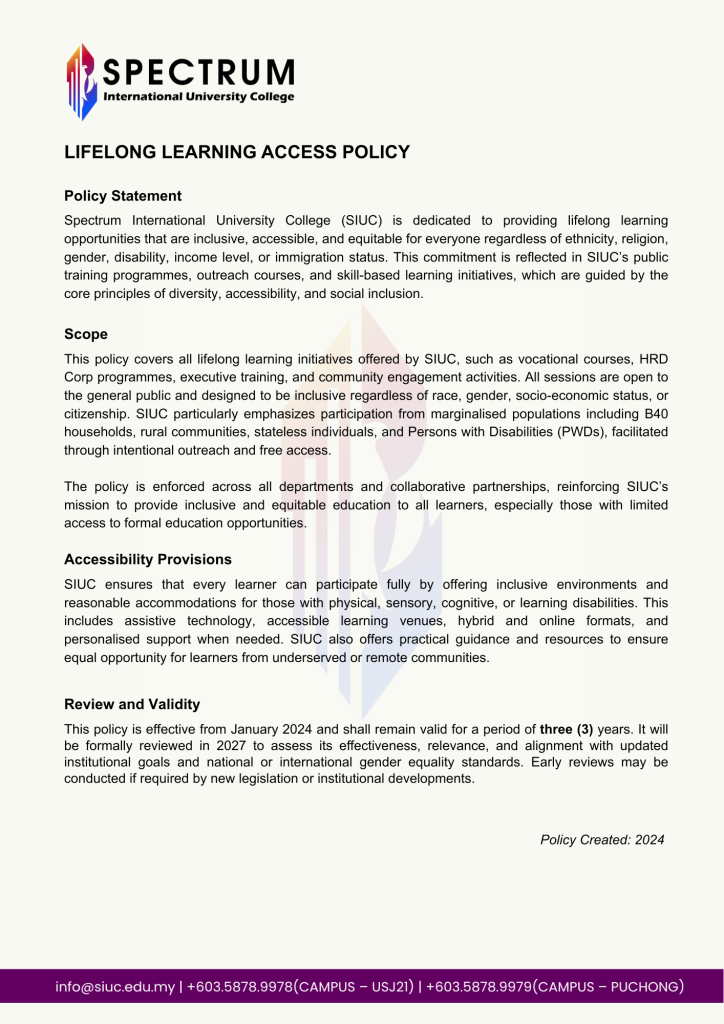
Spectrum International University College (SIUC) has officially enacted a Lifelong Learning Access Policy, effective from January 2024, to ensure equitable, inclusive, and accessible lifelong learning opportunities for all individuals, regardless of ethnicity, religion, gender, disability, socio-economic status, or immigration background. This policy aligns with SIUC’s mission to advance SDG 4 (Quality Education) by removing barriers to education and expanding outreach beyond traditional university students.
The policy applies to all lifelong learning programmes conducted by SIUC, including:
• HRD Corp certified training programmes
• Executive short courses
• Vocational upskilling initiatives
• Community outreach and education activities
All learning programmes are designed to be open to the general public, including those not formally enrolled in the university. Special emphasis is given to ensuring inclusive access for marginalised groups such as B40 households, rural and remote communities, stateless individuals, and Persons with Disabilities (PWDs).
This institutional policy is embedded across all faculties, departments, and training units, ensuring that both in-house and collaborative programmes are delivered with fairness, transparency, and accountability. It strengthens SIUC’s role as a driver of lifelong learning and community empowerment, ensuring that no learner is excluded based on their background or legal status.
The policy includes a clear implementation framework supported by senior management and monitored as part of the university’s quality and governance processes. Programmes conducted under this policy often include public workshops, skill-based certifications, educational seminars, and community-driven initiatives with a growing focus on digital inclusion, professional development, and literacy across generations.
This policy was formally created in 2024 and will remain in effect for a period of three years, with a scheduled review in 2027 to ensure continued relevance and alignment with SIUC’s educational strategy and global benchmarks. It is publicly available via the university’s website and included in official documentation and outreach reports.